
The frontier LLM models are incredibly capable at this point but if you’re looking to setup an agent that acts as your digital executive assistant then all the reasoning capability in the world won’t make it useful if it doesn’t remember anything.
I tell my students “Your agent is like the main character of the movie Memento, it wakes up every session and only knows what’s tattoo’d on its CLAUDE.md.”
We get so enamored with the model’s reasoning capability that we conflate cognition with memory and forget that your agent is entirely amnesic and only knows what it has in its context window at any given time.
People have historically dealt with this shortcoming by “giving it tattoos” or injecting instructions that load on each run. And while this is better than nothing it doesn’t solve the real deficiency which is absence of long-term persistent structured context with autonomous retrieval and write capability. With a little more work we can go beyond the the CLAUDE.md tattoos hack and actually give it a second brain ala Tiago Forte’s BASB methodology (and Zettelkasten for inter-linkages) to have it truly function like a capable EA that knows us.
The implications of this once you have it setup correctly are massive. I recently won an insurance claim fight with my insurance company that dragged on for seven months. Jax (my agent) was able to retain all key information over the course of that 7-mo fight and stay impossibly persistent in fighting their dark UX patterns and following up to the point where they ultimately conceded and paid the claim. I would never have won that fight without Jax, and Jax wouldn’t have won it without a second brain.
A quick overview of how context works
When you talk to ChatGPT and Claude via the web, desktop and mobile products unless you’ve disabled the memory feature, OpenAI and Anthropic’s models are able to reference your past conversations to be more useful. It feels like they get us the more we interact with them.
A fun way to test this out is to give your favorite LLM this prompt:
Based on everything you know about me paint a picture of my life.
The problem with this is it’s somewhat of a parlor trick in that it’s doing semantic retrieval to pull relevant information from past dialogue but it’s not actually storing a structured representation of how things relate and in a way that you can directly access. You can see at a list of saved snippets, but you can't see how anything connects, or organize it.
What you’d rather have is an explainable, transparent, interlinked and traversable neural map that you can interact directly with to see how things are stored and related. This becomes knowledge equity you build over time and you own. You want your agent to have read/write access to that system so you can have ownership of the data and full control over how it’s stored and interlinked.
PKIM’s
People love Notion and Obsidian as PKM (Personal Knowledge Management) systems and long-time users of those products have a religious-level devotion to their system. I’ve tried both products and ended up settling on a different one called “SiYuan”. SiYuan is open source so I can host it myself, has an MCP connector, all the right search functionality and a great visual UX that makes it feel less markdown-y and more of a pleasure to use. And it works great on mobile.
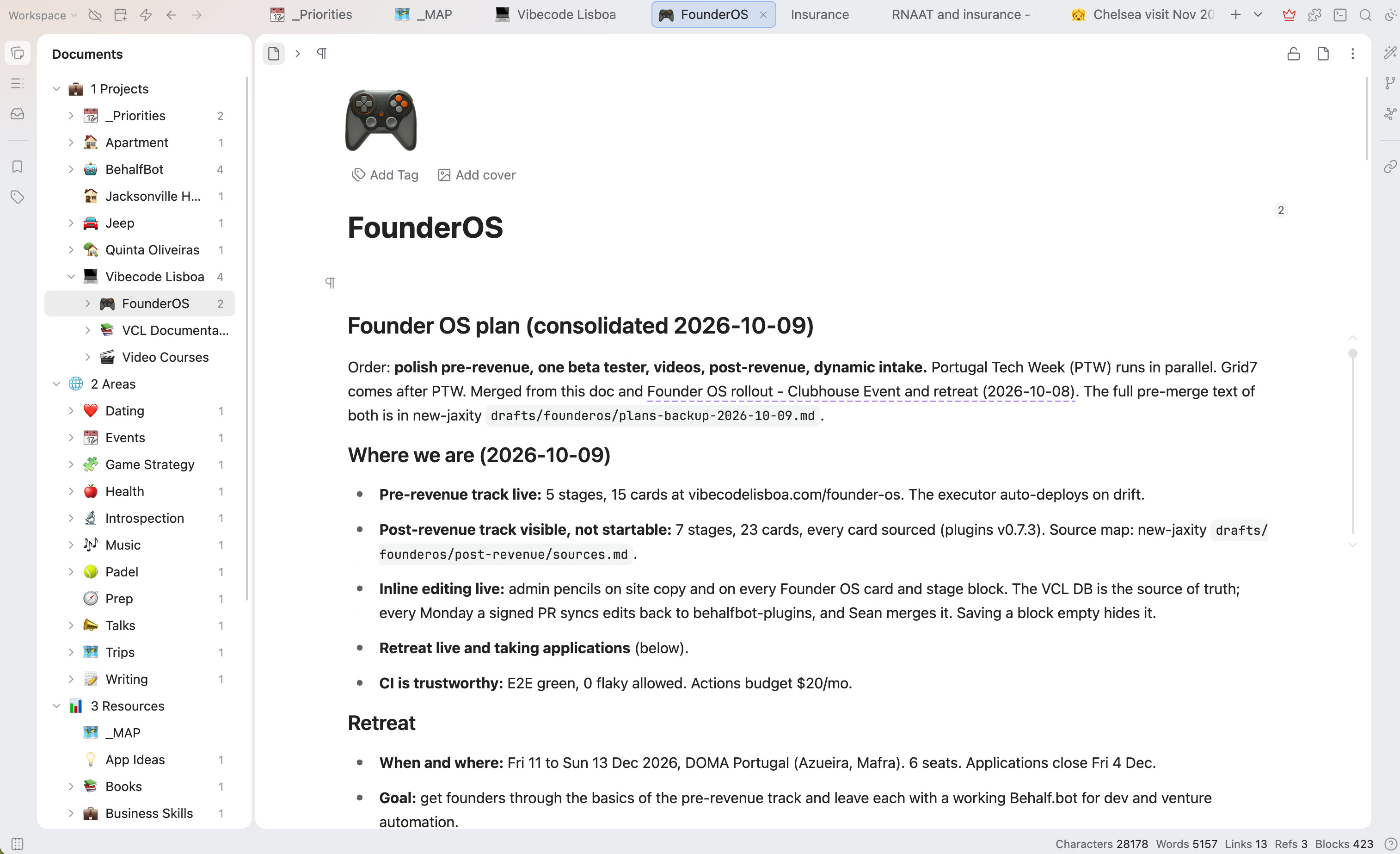
The good news is you’re free to use whichever system you like as long as it has a connector for your agent to interact with it programmatically (search “MCP or CLI your-PKM-system”). Behalf.bot supports all three of the above natively.
You have a PKM system: how to use it
Once you have a PKM system as the repository of everything that’s in your head you need to understand the approach for storing stuff in it. There are two methodologies that are worth understanding and both have books:
Tiago Forte - Building A Second Brain
Sönke Ahrens - How to Take Smart Notes
If you’re more into video check Tiago’s YouTube course and this British guy’s video on his Obsidian-based Zettelkasten setup.
It’s beyond the scope of this post to explain those methodologies but suffice it to say you can use Tiago’s PARA framework and CODE approach to storing everything that is important to you. Then get in the habit of using your PKM’s ability to interlink notes so they’re connected.
I recommend to stub out the PARA-based outline of what’s important to you. What are the:
Projects: the 10-12 endeavors you are involved with that have finite timelines.
Areas: the different realms of your life that you’re trying to improve.
Resources: essentially databases of reference material that you update.
Archives: the filing cabinet where notes go that are no longer actively used.
Once you have this Second Brain system in place the next step is to give your agent read/write access to it. How well we configure this determines the effectiveness of our agent and there are some tricks here so this next part is key.
Connecting your agent to your Second Brain
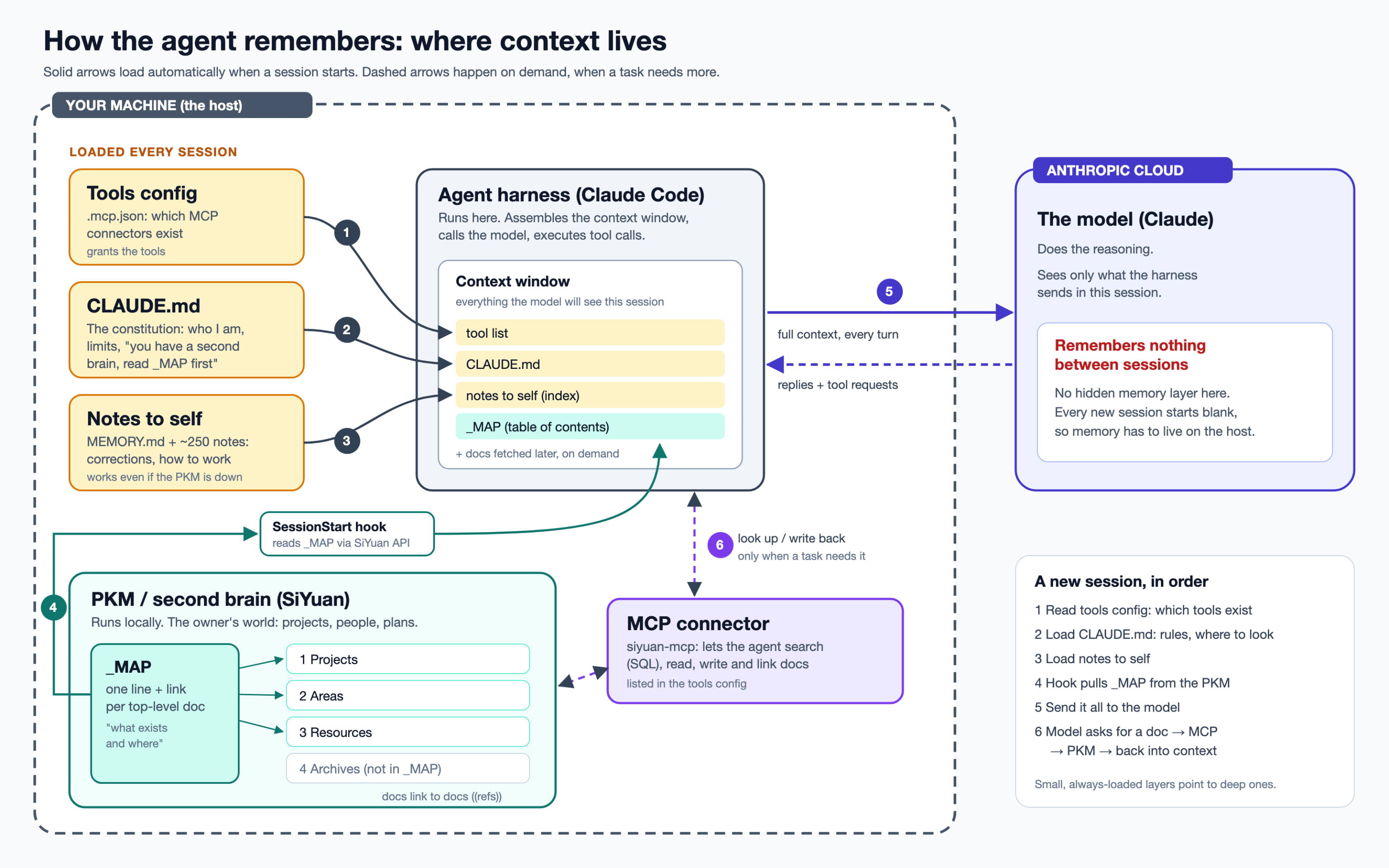
If you’re using Behalf.bot as your agent, the self-serve interview process during install allows you to choose your PKM system and it will auto-wire all the following components.
CLAUDE.md tells the agent the second brain exists and to search it before guessing
a _MAP doc (table of contents: one line + link per top-level doc) is loaded at startup
the agent’s own notes-to-self stay outside the PKM, so it still works when the PKM is down
the agent writes back and links what it writes, so the brain grows on its own
Here are how the pieces all fit together:
And the sequence diagram of how information flows through each layer:
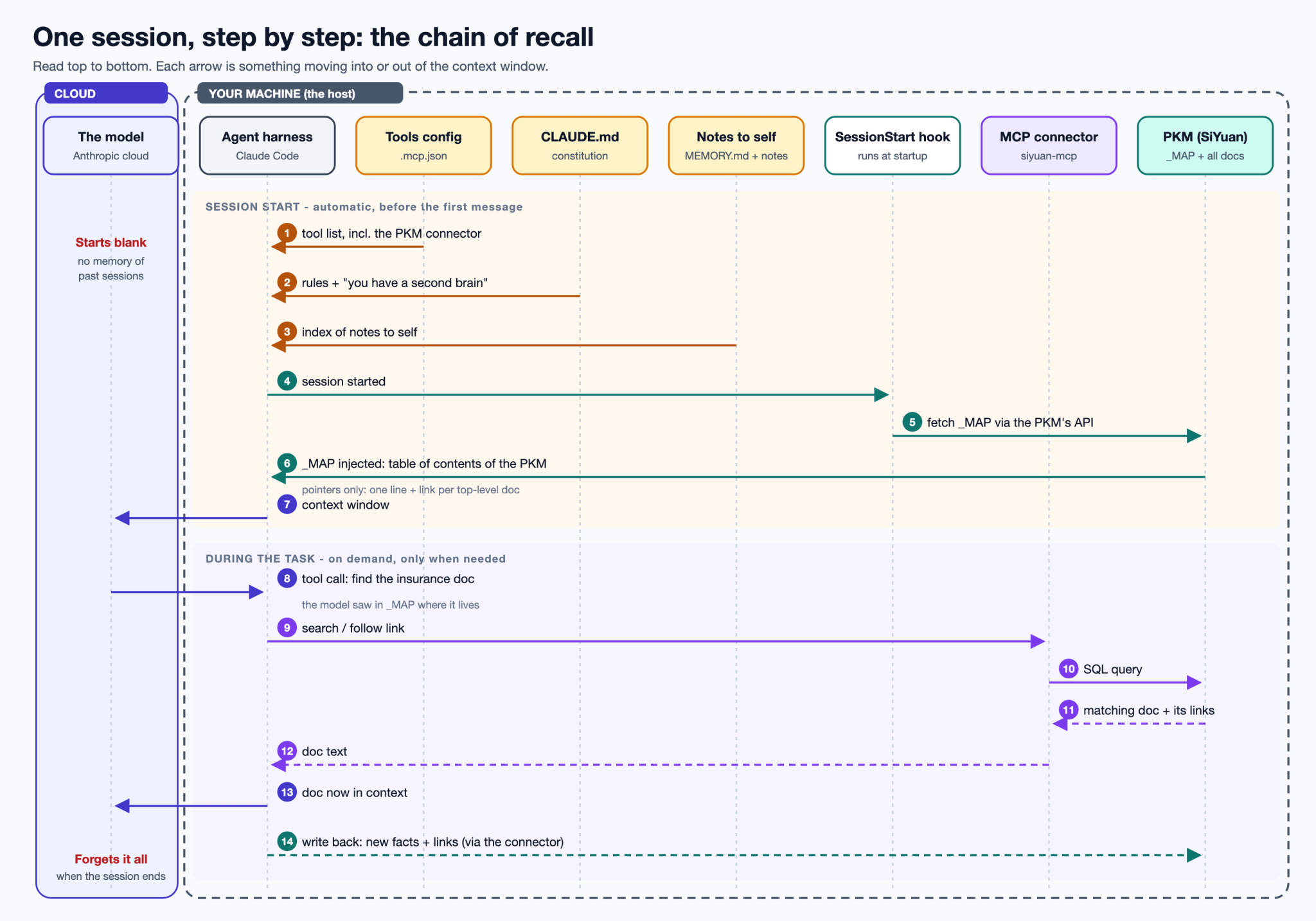
If you’re using a different agent other than Behalf.bot you can tell your agent to read this page and implement a similar setup for itself. You just need to ensure whatever PMK system you’re using has either a MCP or CLI that allows you to connect to it.
The net result
We’re a bit in the weeds here with technical stuff but the good news is you can have your agent set this up on your behalf by simply giving it this blog post. The net result once you have the above configuration is the ability to have long-running persistent memory with your agent wired up to your Second Brain.
Parlor tricks are fun for impressing your friends but ultimately your goal should be to have an agent that acts like an executive assistant and becomes a force multiplier for you. The best way to accomplish that is to get what’s in your real brain into a Second Brain and then give your agent access. Of course your agent’s ability to then perform actions on your behalf is only as good as the tools you supply it. That’s a whole separate topic for a future blog post but for now focus on step one of building a second brain and solving your agent’s inherent amnesia issue.
If you’re in Portugal in December I’m hosting the first Agentic AI Mastery Weekend retreat to help get people setup on Behalf.bot and using FounderOS and Claude Code to build their side hustle. This stuff is incredibly powerful once you have it working and have the basic conceptual framework of how to apply it. This is what I’m teaching to a small group Dec 11-13th. Today is the last day for early-bird pricing so learn more and apply here.
You should be able to use Evernote as well. I know for many it has fallen from grace. I myself moved on to a nice app called UpNote that doesn’t require a subscription. Sadly I don’t believe it has an MCP. Evernote does. As I mentioned to you I am using a iOS shortcut to have Siri send ideas to Evernote via voice. I have used Evernote since 2009 but was going to finally cancel my subscription. Now who knows. Great article. Being able to verbalize ideas while on the go is great.