
Ben: “I missed the syllabus and finished the whole thing in a week”
Ben Lakoff is the General Partner for Bankless Ventures. He’s spent years working with external dev teams and internal tech teams, and he knows what that costs in time and money. He joined Build School to finally understand the tools himself.
“Taking this course was more on the spirit of learning as opposed to developing the next billion dollar idea,” Ben said in his demo. He started with a throwaway project - an AI influencer - and finished it on day one. Then he pivoted to something he actually needed.
MacroDigest is a dashboard that pulls market signals from everywhere: indices, sentiment analysis, Reddit’s WallStreetBets, RSS feeds from analysts he follows. It runs NLP on everything and tries to gauge where markets are heading.
The fun fact of Ben’s story: he didn’t realize there was a syllabus in the beginning. He just dove into the self-paced video course and came out the other side days later with a deployed product. He’d gone through Confabulator, hooked up Stripe, spun up a marketing site and made it all work in the first week of a 30-day course proving Derek Sivers’ point that there is no speed limit.
Petra: Years of waiting, one month of building
Petra runs her own business and came to Build School with an idea she’d been carrying around for years for JustLooking: an app to help people passively scout for promising career opportunities.
“2.59 billion people are passive job seekers,” she explained at demo night. “They’re open to switching jobs if something better comes along. Figuring out what’s better is usually the hardest part.”
Her app works like the Hinge dating app for careers. You swipe through roles. The system learns your preferences over time. It notices when you keep liking remote positions even though you said you wanted hybrid. It builds a calibrated picture of what you actually want - like a recruiter who takes the time to really understand your interests.
“I tried to build this years ago but I didn’t manage.”
In a month with Claude Code and no prior experience she made it real.
From her testimonial: “Claude Code can do pretty much everything you want. That’s not the hard part. The hard part is knowing what you want to build and actually leading Claude into building it.”
Her advice to anyone considering the course? “Don’t wait. Just get started. The first week might feel like you don’t know what you’re doing. But after a week or two, you’ll be self-sustained.”
William: 16 years of events, one month of tools
William has thrown over 500 events in his career, mostly in the nightlife and entertainment space. Sixteen years running he’s a veteran of this space.
He also knows demand for alcohol-centric events is receding. Younger people drink less. Health consciousness is up. Event attendance across the industry is down.
Instead of accepting the down-tick in attendance, William is building features to find and recruit his customers.
“I approached Sean and said these are the first two tools I’m going to start with,” William recounted. “I said I hired a dev company and he said to me, ‘You’re going to fire them.’ I said okay. He said, ‘You’re going to do this yourself.’”
So he did. Six weeks later he built Dynamic Event Suite consisting. Dynamic pricing that works like surge pricing in Uber - set your min and max, and the system adjusts based on actual demand. An affiliate system that turns every ticket buyer into a promoter automatically. Analytics that track where every click and purchase comes from.
“Your best tool has always been your buyers,” William explained. “We turn all your buyers into affiliates for you.”
The social boost feature is already outperforming his paid advertising. His St. Patrick’s Day events in Chicago are live right now with the new tools running.
“I don’t want to personally respond to questions about why things are so unfair while you’re drunk at 2 a.m. anymore,” he joked. “I’ve earned it after 16 years. I want Claude to take care of that for me.”
Koos: The language learner who built a better Anki
Koos is Dutch, living in Portugal, and frustrated with current language learning apps. He’d used Anki previously - the spaced repetition tool that everyone recommends and nobody enjoys. It works, but it’s cumbersome, uses an antiquated algorithm and doesn’t tailor specifically to the words you use everyday.
His insight: vocabulary should be contextual. You should learn words relevant to your actual life, in the dialect spoken around you. His Brazilian Portuguese is out of place in Lisbon so he’s using his app to teach himself European Portuguese.
He built Learn the Language you Live In (currently US/China only - if in Europe take Koos’ survey here) to be his own spaced repetition system. It’s an iOS app that makes vocabulary learning contextual to your location and your life.
Koos has the most commits of anyone in the cohort. Feature after feature, refinement after refinement he’s tweaked it to be exactly the tool he himself wanted and has now made it available to others via the Apple App Store.
Cristiano: Capturing stories before they disappear
Cristiano cares about legacy. About the stories families carry forward and what gets lost when people pass without recording them.
He built Mabel, an iOS app that acts like a guided memoir-authoring interviewer and coach. You speak into the app via voice notes. An AI interviewer prompts you, draws out your stories the way a skilled biographer would.
Using his app anyone can speak an autobiography into existence.
Think about your grandparents. The stories they carry that you’ve never heard. The ones that will disappear when they do. Cristiano’s app makes it almost effortless to capture them. No writing required - talking is the UX so anyone can use it including your grandparents.
What these five have in common
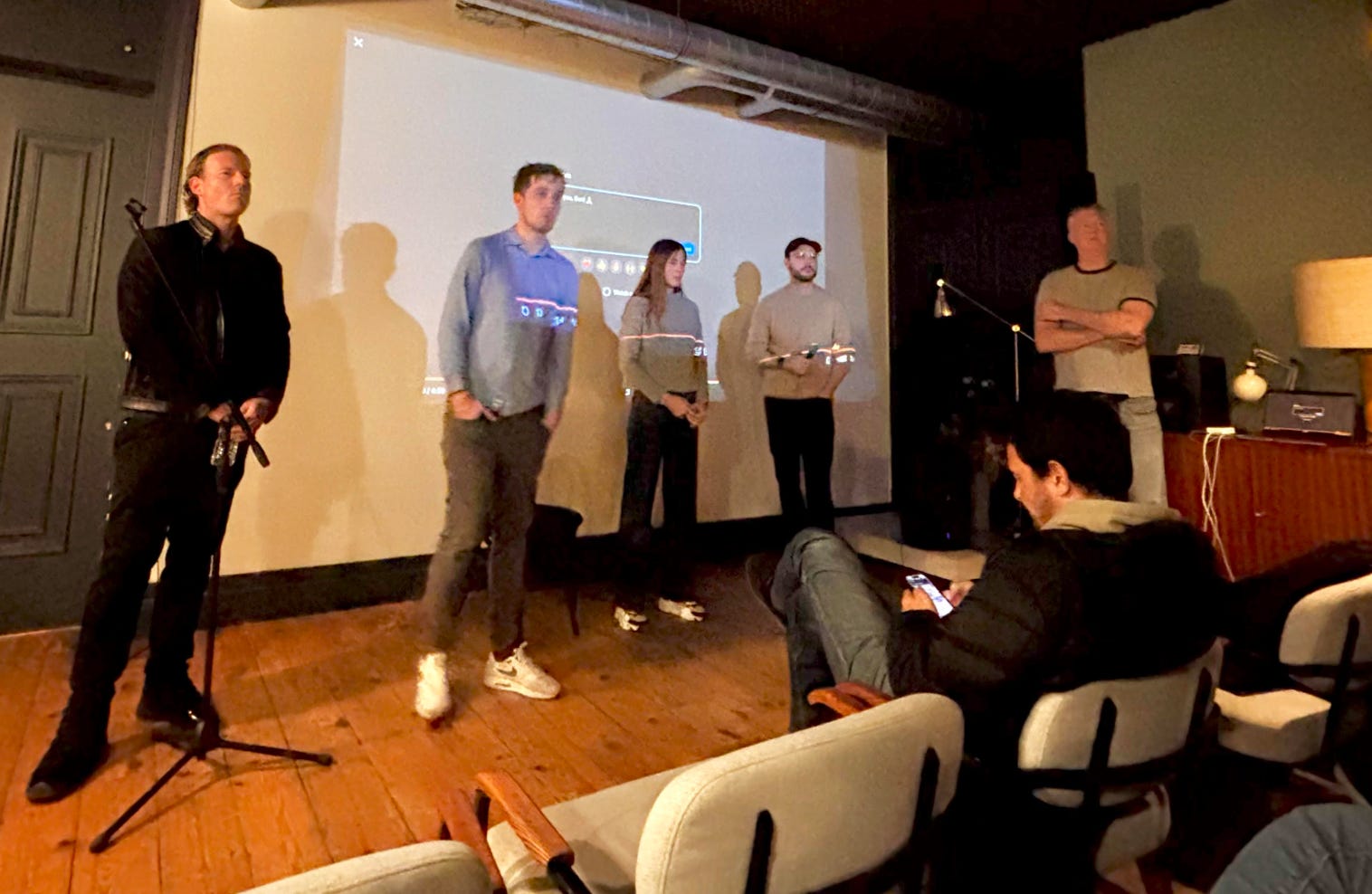
They built tools for themselves. Ben wanted market intelligence. William wanted event optimization. Koos wanted better language learning. Petra wanted a career exploration tool. Christiano wanted legacy preservation. They had strong visions and willed these into existence via natural language.
They prove the thesis of Build School: that the tools have evolved to the point that with a small amount of hand-holding anyone regardless of background can use natural language to make their dream reality.
Cohort 3 begins
We kicked off Cohort 3 on Monday with eight students - our biggest cohort yet.
Applications for Cohort 4 starting April 20th are now open. Early-bird pricing runs until April 1st.
If you have an app idea you’ve been carrying around, if you’ve been waiting for a technical co-founder who hasn’t shown up, if you’re curious whether you could actually build the thing yourself - this is for you.
Build School is a 30-day sprint. You show up with an idea. You leave with a deployed MVP. And in the process you learn a mindset and system that you’ll be able to leverage for the rest of your life. Come see what it’s all about.
Learn more about Build School →
About 60 people came out for demo night. If you’re in Lisbon, join us at the next Vibecode Lisboa meetup. If you want to build, start with Confabulator to lay your project foundation.